

In today’s always-on digital economy, businesses cannot afford downtime, slow response times, or inefficient technical support. Whether you’re a startup scaling rapidly or an enterprise optimizing operational costs, outsourcing IT support has become a strategic necessity.
According to external technical support models reviewed by DesignRush, organizations are increasingly adopting flexible outsourcing structures to improve service quality, reduce expenses, and gain access to specialized expertise.
Why Businesses Are Outsourcing Technical Support
Modern companies are moving toward outsourced support for several key reasons:
-
Access to skilled global talent without long hiring cycles
-
24/7 customer and system support
-
Reduced infrastructure and operational costs
-
Faster implementation of new technologies
-
Improved risk management and data security
Outsourcing also eliminates hidden in-house expenses like hardware, software licenses, training, and employee benefits, making it a scalable and cost-efficient solution.
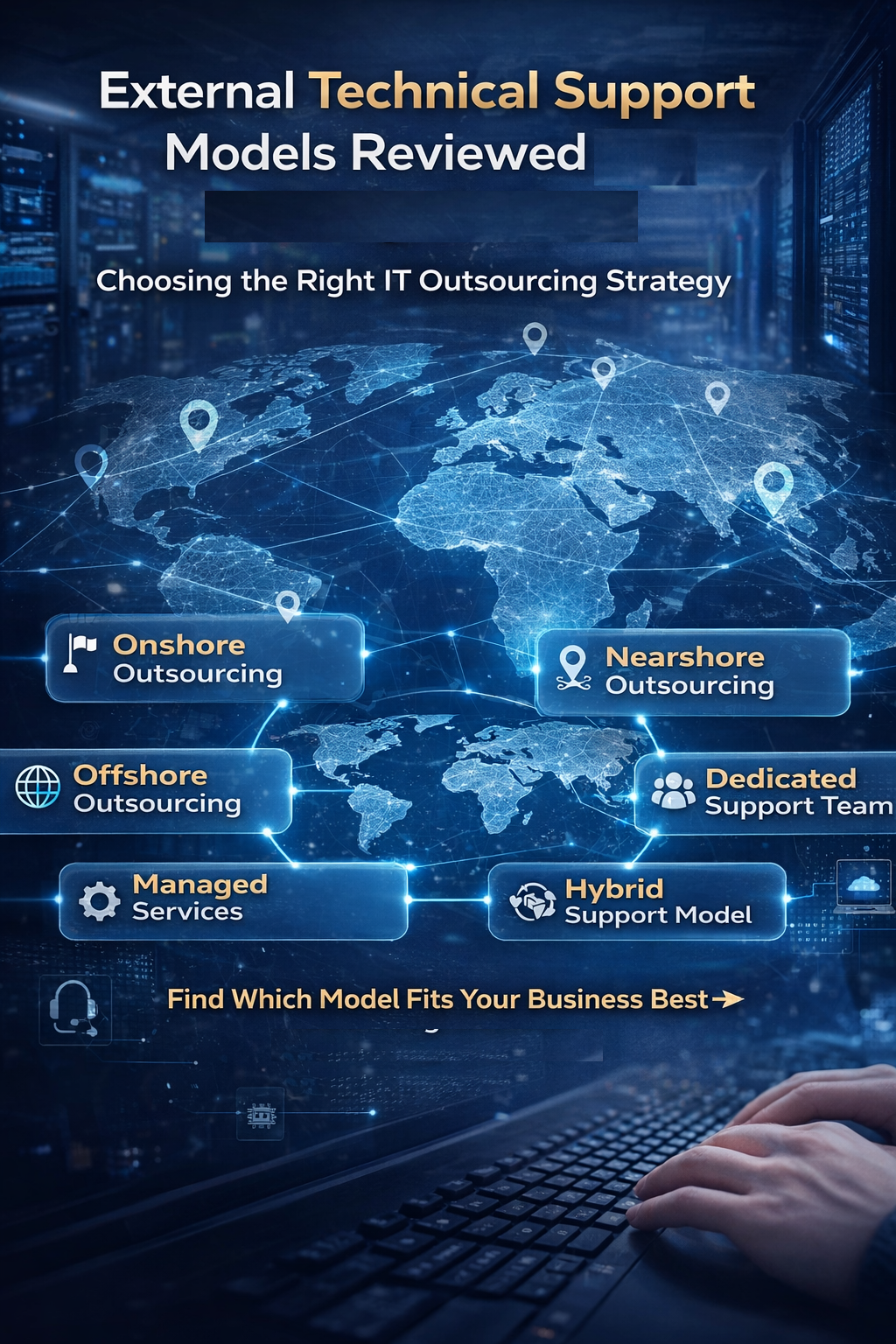
Core Technical Support Outsourcing Models
1. Onshore Outsourcing
This model involves partnering with a provider in the same country.
Best for:
-
Companies with strict compliance requirements
-
Businesses that need strong cultural and language alignment
-
High-touch customer experience
Pros:
-
Easy communication
-
Local regulatory compliance
-
Strong brand consistency
Consideration: Higher cost compared to offshore options.
2. Nearshore Outsourcing
Nearshore support uses teams in neighboring countries with similar time zones.
Best for:
-
Real-time collaboration
-
Cost-quality balance
-
Agile development environments
Pros:
-
Lower cost than onshore
-
Minimal time-zone challenges
-
Faster response cycles
3. Offshore Outsourcing
Offshore support is the most cost-effective and widely used model.
Best for:
-
24/7 technical support
-
High-volume customer queries
-
Startups and SMBs scaling globally
Pros:
-
Significant cost savings
-
Round-the-clock coverage
-
Multilingual support teams
Challenge: Requires strong onboarding and SOPs to maintain brand tone and quality.
4. Dedicated Support Team Model
In this approach, a team works exclusively for your business.
Best for:
-
Long-term outsourcing partnerships
-
Product companies
-
SaaS platforms
Pros:
-
Full control over workflows
-
Brand-aligned support
-
Consistent service delivery
5. Managed Services Model
Here, the outsourcing provider handles everything—from staffing to performance tracking.
Best for:
-
Companies that want to focus on core business functions
-
Fast-growing organizations
Pros:
-
End-to-end responsibility
-
Predictable SLAs
-
Performance-driven results
6. Hybrid Support Model
A combination of in-house and outsourced teams.
Best for:
-
Enterprises with complex support structures
-
Businesses are testing outsourcing gradually
Pros:
-
High control for critical tasks
-
Cost efficiency for routine operations
-
Scalable support ecosystem
How to Choose the Right Model
When selecting a technical support outsourcing model, consider:
-
Business size and growth stage
-
Budget and cost optimization goals
-
Required support hours (business hours vs 24/7)
-
Customer experience expectations
-
Compliance and data security needs
The right partner should act as an extension of your internal team, not just a vendor—bringing innovation, documentation, and faster time-to-market.
Final Thoughts
Technical support outsourcing is no longer just a cost-cutting tactic—it’s a growth strategy.
By leveraging the external technical support models reviewed by us, businesses can:
-
Improve operational efficiency
-
Deliver better customer experiences
-
Scale globally with confidence
-
Stay competitive in a technology-driven marketplace
Choosing the right outsourcing model ensures your IT support becomes a powerful driver of business success rather than a reactive function.

 By
By




 By
By